

Your domains. One clear view.
Look up any domain and see its registration, DNS, mail, hosting and certificate in one report. Each result shows its source and the time it was observed.
Public sources and registries the lookups query
Names identify data sources. They do not imply partnership or endorsement.
Lookup tools
Use the full report, or go straight to the one answer you need. Every tool is free and works without an account.
Domain lookup: the full report for any domain
Enter a domain and get registration data, DNS records, mail configuration, hosting network and the TLS certificate on one page. Every section is fetched live and shows where the data came from and when.
WHOIS lookup
Check who a domain is registered through, when it was created, when it expires and what its status codes mean. Data is read live from the registry's RDAP service, the modern replacement for WHOIS.
DNS lookup
Query the DNS records of any domain or hostname and see values and TTLs as public resolvers return them right now.
MX lookup with SPF and DMARC check
See which mail servers accept email for a domain and whether its SPF and DMARC records are present and well formed.
Domain IP lookup: find where a website is hosted
Resolve a domain to its IP addresses and see the reverse DNS name, the autonomous system and the network owner for each one.
SSL certificate checker
Connect to a domain over HTTPS and inspect the certificate it presents: who issued it, when it expires, which names it covers and whether the chain is trusted.
DNS propagation checker
Changed an A record, moved nameservers or updated MX? Ask ten independent public resolvers for the same record at once and see which ones already return the new value.
NS lookup: find the nameservers of a domain
See which nameservers answer for a domain, and whether the NS records in DNS agree with the delegation held at the registry.
SPF record checker
Look up the SPF record of a domain and see the problems that most often break it: more than one record, +all, no all mechanism, or too many DNS lookups.
DMARC record checker
Look up the DMARC record of a domain, see which policy it publishes and whether the record is missing, duplicated or invalid.
Domain age checker
Find out when a domain was first registered, how old it is today, and when it was last updated and will expire.
Website status checker: is it up or down?
Request a website live and see whether it answers, how fast, with which HTTP status, which server software, and what title and description the page declares.
HTTP header checker
See exactly which response headers a website sends: server and caching headers, cookie attributes, and the security headers browsers act on.
Redirect checker: trace the full redirect chain
Follow a domain from the first request to the final page and see every redirect on the way, with its status code and destination.
DKIM checker: look up a DKIM key
Look up the DKIM public key a domain publishes for a selector, or try the default selectors of common mail providers, and see whether the key parses, how long it is and whether it is revoked.
Subdomain finder
List the hostnames of a domain that appear in public Certificate Transparency logs: a quick inventory of what has been given a TLS certificate.
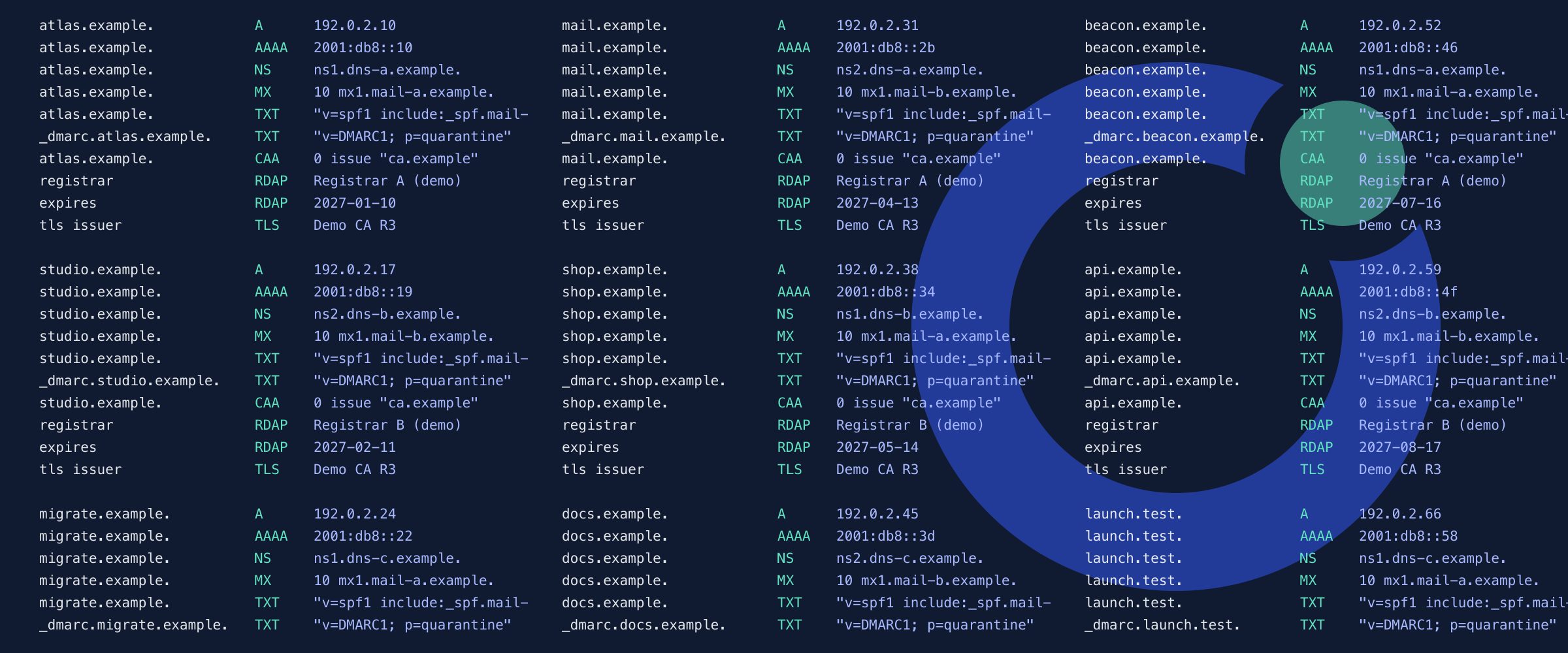
Every domain. In view.
A report starts as a blur of separate systems: registry, DNS, mail, network, certificate. Move across the sample to bring it into focus.
One domain in, five sources, one report
Each lookup queries independent public sources in parallel. Every section of the report names its source and the time it was observed, and a source that fails is shown as unknown rather than guessed.
- RDAP · WHOISRegistrar, dates, status, nameserversregistry RDAP · port-43 WHOIS
- DNS recordsA, AAAA, NS, MX, TXT, CAA, SOApublic resolvers
- MX · SPF · DMARCMail hosts and sender policy findingsDNS TXT + MX
- IP · ASN · networkNetwork operator, prefix, reverse DNSTeam Cymru · RIR RDAP
- HTTPS · TLSStatus, redirects, certificate, headersdirect request
 OrbitProbe reportEvery section: source + time observed
Live lookups run from a single location today.
From information to a finished action
Most tools stop at a lookup. OrbitProbe connects what you found to what you do next, and follows it through.
Inspect → save → watch → confirm
- Inspect a domain and its infrastructure
- Save it to your private portfolio
- Watch an expected nameserver change
- Get a notification scoped to the locations that were measured
Search → compare → acquire → track
- Search for a name
- Compare first-year, renewal and transfer prices
- Register it with the provider you choose
- Add it to your portfolio yourself and track renewals
Every registrar, one table
Expiry dates with their source, renewal cost per currency, auto-renew that says “unknown” when it is unknown, and reminders 30, 14, 7 and 1 day out. Your portfolio is private: nothing is public or for sale unless you publish a listing.
Know when a DNS change has actually landed
Set the exact nameserver set or record you expect. OrbitProbe reports how many monitored locations match, which still show the old value and which could not be checked. No vague “propagation” percentages.
Sell only what you choose to list
Listings are opt-in, with a control check, clear asking price or make-offer terms, and both seller and buyer fees shown before any agreement. Payments and transfers need a partner integration and are not simulated.
Lookup activity, last 24 hours
Real, aggregate numbers from this server. Nothing here is simulated.
Only country counters are kept. No IP addresses and no domain names are stored for this view.
Blog
Read moreCAA Records Explained: Control Who Can Issue Your Certificates
What a CAA record is, how CAs evaluate it (tree climbing, CNAMEs, issue vs issuewild), ready-to-use examples, and how to add one without breaking renewals.
Guides · 7 min readFinding the Origin IP Behind a CDN: Limits and Ethics
Why an IP lookup shows CDN edge addresses, why the origin IP behind a CDN usually cannot and should not be found, and how owners protect their own origin.
Guides · 6 min readDNS Record Types Explained: A, AAAA, CNAME, MX, TXT and More
What each DNS record type does, how it looks in a zone, the rules that trip people up (CNAME at apex, MX targets, TXT length) and how to query each with dig.
FAQ
What is OrbitProbe?
OrbitProbe is a domain intelligence tool. It reads public registration data, DNS records and HTTPS responses for a domain and presents them in one report. The workspace adds a portfolio with renewal reminders and DNS change watches.
Is it free to use?
The lookup tools on this site are free and need no account. Requests are rate limited so the service stays responsive and does not burden the registries and resolvers it queries.
Where does the data come from?
From public sources queried at the moment you search: RDAP servers for registration data, public DNS resolvers for records, and a direct HTTPS request for web and certificate details. Each section names its source and observation time.
Can OrbitProbe show who owns a domain?
Only when that information is public. Most registrant contact data has been redacted since 2018, and OrbitProbe shows redacted fields as redacted. It does not buy, guess or reconstruct personal data.
Does OrbitProbe scan or attack the domains I look up?
No. It sends ordinary DNS queries, reads the public RDAP record and makes one standard HTTPS request, the same things a browser and a resolver do. It does not port scan, brute-force subdomains or try to find hidden origin servers.